Rethinking Insulation: How TSM Ceramic Outperforms Legacy Materials
For decades, insulation has meant bulky materials like expanded polystyrene (EPS) and mineral wool. But as energy efficiency, safety, and sustainability standards have risen, these solutions have revealed serious shortcomings: flammability, condensation problems, health risks, excess bulk, and a heavy environmental footprint. TSM Ceramic, an innovative liquid ceramic insulation, offers a modern alternative. Applied as a thin, seamless layer, it provides durability, fire resistance, moisture protection, and certified eco-compliance.
Fire Safety: A1 vs. Combustible Legacy Materials
EPS boards ignite easily. As a petrochemical plastic, they burn rapidly, spread flames, and release toxic smoke. Even “fire-retardant” EPS relies on chemical additives that offer only limited protection while raising health concerns. Mineral wool itself is non-combustible (Euroclass A1), but in practice its performance is reduced by adhesives, facings, and vapor barriers.
TSM Ceramic is certified as an A1 non-combustible material. Tests confirmed compliance with EN 13501-1:2019 — the highest European fire safety classification. The coating does not ignite or sustain flames, even under direct fire exposure. A 1 mm layer only chars at ~500 °C and decomposes at ~840 °C, slowing flame spread instead of feeding it. Importantly, it achieves this without toxic flame-retardant additives.
Moisture and Condensation: Dry Where Others Fail
Mineral wool can absorb up to 70% of its weight in water, takes days to dry, and loses most of its insulating properties in the process. EPS resists bulk water but can trap hidden moisture behind boards, leading to rot and corrosion. Both systems are vulnerable to condensation — cold bridges where dampness, mold, and corrosion start.
TSM Ceramic creates a seamless, water- and vapor-permeable coating. Testing confirmed its low capillary water absorption (W2 class). The coating seals surfaces against liquid water while remaining breathable, preventing trapped moisture. It also raises surface temperature above the dew point, completely eliminating condensation on walls, pipes, and tanks.
Health and Safety: Clean, Non-Toxic, Easy to Apply
Installing mineral wool and fiberglass releases airborne fibers that irritate skin and lungs. They often contain phenol-formaldehyde binders. EPS includes chemical flame retardants, some of which have already been banned.
TSM Ceramic is safe for health. Testing under EN 16516:2017+A1:2020 showed extremely low emissions: - TVOC (28 days): 387 µg/m³ (limit: 1000) - Formaldehyde: 5 µg/m³ (limit: 60) - All other VOCs within European thresholds
This makes TSM Ceramic fully compliant with CAM criteria and aligned with LEED, WELL, and BREEAM standards. As a water-based, solvent-free coating, it can be safely applied indoors without special protective gear.
Sustainability: Cutting Emissions and Reducing Waste
EPS is petroleum-based, non-biodegradable, and rarely recycled. Mineral wool is made from abundant raw materials, but its production is extremely energy-intensive: melting rock at ~1500 °C generates high CO₂ emissions.
TSM Ceramic drastically cuts carbon emissions and reduces waste. Certified under CAM (Italy), it meets ecological standards for public projects and contributes to LEED and BREEAM credits. With a service life of over 30 years, it minimizes replacement cycles and waste, lowering environmental impact.
Thickness Matters: Millimeters Instead of Centimeters
Legacy insulation requires 10–20 cm of thickness to meet today’s standards. This adds weight, reduces usable space, and complicates installation, especially in renovations and historic buildings. In industry, bulky wraps on pipes and tanks hinder access and hide corrosion.
TSM Ceramic works differently. Its efficiency comes from hollow ceramic microspheres filled with rarefied air. Inside, heat transfer is nearly eliminated: thermal flow is forced to refract multiple times and lose energy, while the vacuum-like cavities block convection. In addition, the material reflects radiant heat, reducing thermal radiation transfer. As a result, its relative thermal conductivity is just 0.001–0.003 W/(m·°C), far lower than legacy materials.
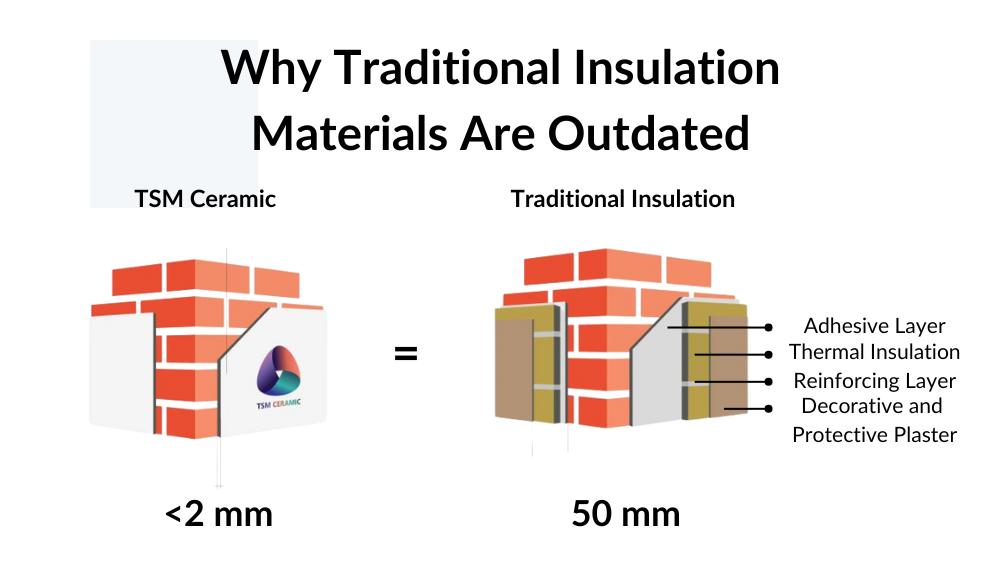
Practical data show that less than 2 mm of TSM Ceramic is equivalent to about 50 mm of mineral wool. Thus, replacing a legacy insulation layer of 100–200 mm requires only 2–4 mm of TSM Ceramic. This radically reduces structural load, frees space, and opens new architectural options without sacrificing efficiency.
Application: Faster, Simpler, Seamless
Installing EPS or mineral wool requires cutting, fastening, sealing, and cladding — a labor-intensive process prone to errors and thermal bridges.
TSM Ceramic is 6–8 times faster to apply. The ready-to-use liquid is sprayed or brushed onto any surface, conforming perfectly to domes, pipes, tanks, or decorative facades. No joints, no gaps, no thermal bridges. In case of damage, repairs are simple — a new layer can be applied directly over the old one.
Certification and Proven Performance
Fire Safety (A1): TÜV SÜD (EN 13501-1:2019)
Environmental Compliance (CAM): Istituto Giordano (VOC testing under EN 16516)
Durability: Service life of 30+ years, with real projects in use for over 15 years
Temperature Range: -60 °C to +210 °C